
Section 7 - Leading a Hike/Walk
Leading a Hike/Walk - On the Day
Must be done
Arrive early - at least 15 mins prior to the walk start, so you can greet all participants as they arrive. Some will definitely be early, so it's important you are there to make them feel welcome.
Keep an eye out for new participants so you can acknowledge them the second they arrive. This is crucial to make new people feel welcome. This may mean interrupting the conversation you are in, so excuse yourself politely to welcome the newcomer.
Confirm all group members are present before moving off. Take the attendance list on Groups.Place. Be sensitive to late arrivals, do a quick check of the carpark to see if there are any participants who may be joining your group. Wait for latecomers for 10mins before leaving (unless they have messaged you).
Acknowledgement of country It is respectful to acknowledge the traditional owners of the land we hike on. Whether that be at the start of the hike, or in the hike description on Groups. Place (or both). To start with it can seem daunting, but it’s actually really easy, and will become second nature after you have done it a few times.
How to do it?
Using google, look up the traditional owners of the land you are on. The Parks Vic website includes it for some parks. If you find this info, refer to the owners specifically. Pronunciation can sometimes be challenging but try your best.Specific — this should be used where there are no disputes and you know the name of the people on whose land you are gathered. The words are:
'I would like to begin by acknowledging the <insert name of people here (e.g. Ngunnawal)> people, Traditional Custodians of the land on which we <gather/meet> today, and pay my respects to their Elders past and present. I extend that respect to Aboriginal and Torres Strait Islander peoples here today.'
Generic — this should be used if you don’t know the name of the people on whose land you are gathered, or if there are disputes about the land (multiple Aboriginal peoples identify as Traditional Custodians for that area). The words are:
'I would like to begin by acknowledging the Traditional Custodians of the land on which we <gather/meet> today, and pay my respects to their Elders past and present. I extend that respect to Aboriginal and Torres Strait Islander peoples here today.'
Introduce yourself and group members. Have everyone form a loose circle, and ask everyone to say their name, where they are from and something fun (ie. colour of their undies or socks, or what they had for breaky, if they have any pets or plants, or something they are proud of). Start with yourself, and add your pronoun/s.
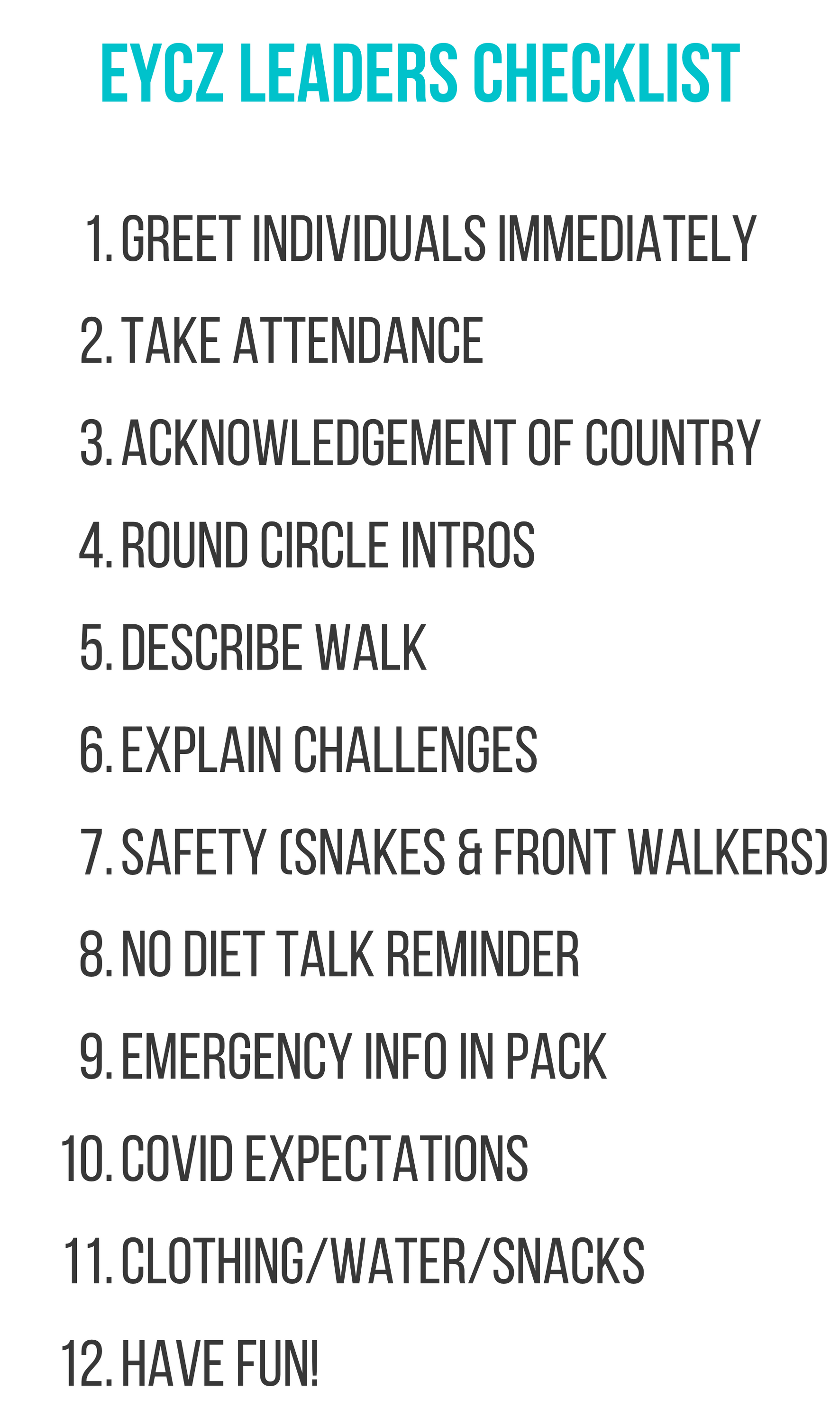
Brief the group on the day’s activities
challenges (if any),
safety procedures including the snake talk (eg. there may be snakes, please make sure you watch where you are stepping, especially if stepping off the trail), and for anyone at the front of the group to stop at every junction, or every 10 mins where there's no junctions.
reminder that we don't talk about diets etc.
cover trail etiquette including leave no trace (this included no rubbish, including fruit, left in the bush), and leaving pack at side of trail if stepping off trail for a toilet stop so we know where to start looking if they go missing.
make sure that everyone is well equipped for the hike (layers of clothing, plenty of water and snacks etc...)
check that everyone is comfortable before heading out.
These cue cards will be created for leaders for quick reference on the trail:

Lead from the back. The reason we lead from the back is that we recognise how demoralizing it can feel to be the "last" person, how negative self talk can occur for slower participants when they see the group getting further ahead, and the gap extending. By leading from the back you ensure that, regardless of the pace, no one ever feels left behind. This is what makes EYCZ hikes unique. Be prepared to have a loud voice if you need to catch the attention of participants at the front of the group (which is why its important you make it clear to them that they need to stop regularly).
Appoint a trusted participant to stay at the front of the group (as the leader you should always lead from the back) to keep faster participants from charging ahead.
Regularly check group members are present especially at stops or during difficult conditions.
Should a participant have a child who needs a break on the hike, pause the hike. Give them a chance to try to stay with the group. Speak with them one-on-one and see if they would prefer to have one person stay with them to finish the hike or stick with the group. Use your best judgement as it is always best to keep the group together.
If someone is not feeling well or has a medical situation, be sure that someone capable walks that participant back to their car, waits with them until they feel okay, and then get their number and check in with them later in the day.
Monitor the wellbeing of group members. Other experienced group members can assist with this. Slow the group down if needed. Take lots of "photo" stops, or announce you personally need a break - these are good tools for slowing the group down without singling out a struggling participant.
Observe the weather. If bad weather is imminent take action to minimise its effects.
Monitor progress and the route being followed against the trip plan and objectives.
Manage the pace of the group; slow at first, then settle on the speed of the slowest member
Rest at regular intervals. 5 minutes every half hour is typical, more if required.
Keep the group together, especially in challenging conditions.
Set limits on fast walkers; how far ahead they may go, conditions permitting. Suggest they stop every 10 mins, or at every track junction (whichever occurs sooner) for the group to regroup
Encourage weaker or inexperienced members
If a difficulty arises, stop, consider and discuss the situation with other experienced members.
Monitor novices and provide advice, e.g. clothing for bleak conditions, water consumption in hot weather
Advise on water availability and ensure regular consumption during the day
Observe regulations and permit requirements, e.g. for camp fires, or for closed tracks.
Respect private property. Avoid stock, use gates and leave as found.
Respect the rights of others to enjoy the bush. Lead by example and greet other walkers as you pass. When new participants see this as normal, they may develop these habits too.
At the end of the hike. Say goodbye to everyone individually. Tell participants if they have any questions, you are available.
Ensure everyone in your group's car starts before you leave. We frequently have people getting flat batteries, and it is your responsibility as a leader to ensure no one is left stranded.
Reverse Park into all parking spaces, and encourage your participants to do the same. In case of an emergency, this ensures the fast, safe departure from the area. (Think about if there’s a fire, and 20 cars are all trying to reverse out of a carpark at the same time in a panic). In addition, it provides easy access to the engine if a car needs to be jump started.
SAFETY TIPS DURING THE WALK/HIKE
Keep an Eye Out for Trail Markers
Many trails are marked with signs to help participants stay on the trail, as well as avoid trampling vegetation and getting lost. A good hiking leader knows what trail markers to look for and keeps a mental note of when they saw the last one. If the trail starts to get sketchy or it’s unclear where it leads next, the leader should stop and think back to when they saw the last trail marker. If the leader isn’t 100% confident that he or she is on the trail at all times, they might lead the group astray for quite a while before anyone else notices or says something.
Stop at River Crossings and Trail Junctions
Any time the trail forks or presents multiple paths, it’s very important that you wait for everyone in your group to catch up before continuing on down the trail. The most common way that groups get split up and participants end up lost is when they’re too spread out to see each other and end up taking different paths at the same junction. If you find yourself with time to kill while you wait for the last members of your group to catch up, junctions and river crossings present a great opportunity to locate yourself on your map, since they’re usually well marked. Confirm you’re on the right path, and see what’s up ahead so you can inform the group.
Know What Challenges Lie Ahead
A good trail leader knows what lies ahead, and keeps the group well-informed so everyone knows what to expect. Does it get steeper? How far is it to the next water source? When will we reach the campsite or carpark?
Knowing what challenges lie ahead – and keeping the group well-informed about those challenges – goes a long way to managing everyone’s expectations and keeping morale up.
Manage the Group's Pace
There’s a common saying among participants that you should “hike your own hike” (HYOH). Part of that means setting a pace you are comfortable with and sticking with it.
It’s important to recognize how your pace impacts everyone else’s pace, and in turn, affects how they all feel about the hike. Participants join EYCZ with the expectation that leaders will not push them to go fast. If you’re going fast, some people will try to keep up with you, pushing their heart rate up higher than they’d like, which will wear them down more quickly. They’ll struggle more over steep terrain and need to take longer breaks to feel comfortable.
Leading from the back The reason we lead from the back is that we recognise how demoralizing it can feel to be the "last" person, how negative self talk can occur for slower participants when they see the group getting further ahead, and the gap extending. By leading from the back you ensure that, regardless of the pace, no one ever feels left behind. This is what makes EYCZ hikes unique. Be prepared to have a loud voice if you need to catch the attention of participants at the front of the group (which is why its important you make it clear to them that they need to stop regularly)Whenever the group stops to take breaks, be proactive and ask how everyone’s feeling with the pace so far.
Allowing time for slower participants to take a break Think about the scenario where there's a hill. Faster walkers will get to the top first, and take a few minutes to have a rest as they wait for the tail end participants. You MUST make sure that those tail end participants are given enough of a break. Do not ever take the approach of "ok, everyone’s here, lets keep moving", as this is unfair to those who have not had a well deserved break. Along this topic, when waiting for a slower walker, don't stare at them as they are making their way up the hill. Its the natural place to look, as that’s where the action is, but consider that if a participant is struggling up a hill, they won't feel comfortable being watched.
Set Everyone's Expectations When Taking Breaks
Inevitably, people will need to take a break to change layers, grab a snack or use the bathroom. Whenever the group agrees to stop, it’s a great idea to quickly establish how long the break will be so that everyone is on the same page.
I usually try to establish whether the break will be:
2 Minutes - For grabbing a snack or water, or switching layers
5 Minutes - Bathroom breaks, checking the map, enjoying a quick view, taking photos
30 Minutes - Making a meal, enjoying a summit, tending to first aid
If you don’t set expectations, people end up sitting around not knowing if they have time to take care of something, and then getting cold and anxious. Someone assumes it’s a 2-minute break and leaves their pack on, but after a minute, someone else decides they need to run off to use the bathroom. After they’ve been gone for a few minutes, the first person decides to sit down, take their pack off and air their feet out, just as the bathroom person is coming back, and then someone else decides to start making a sandwich…
For longer breaks, I also like to give a “2-minute warning” before we start hiking again, so that people know that now’s the time to grab that last handful of trail mix and start packing their bag back up. Make sure you stop for enough time that the person in the back has all the time they need to rest and take care of issues as well.
Be Proactive About Keeping Everyone Comfortable
As a trail leader, it’s good to periodically remind the group about certain issues and see if anyone wants to stop and address them.
On chilly days, after 15 minutes of hiking I’ll ask if anyone has started sweating in their jacket and wants to stop to drop a layer. People start out chilly and put on too many layers, but after 15 minutes of hiking they’re sweating profusely and haven’t taken anything off.
On warm days, I’ll ask people if their feet feel warm or sweaty, or if there are any problem spots forming. Warm and sweaty feet start to turn into hot spots which rub the skin until a painful blister ruins the trip.
By mid-day, I’ll make sure everyone had peed within the last 3-4 hours or ask how much water they’ve gone through, to see if they’re staying properly hydrated. Even if they have a water bladder or bottle close at hand, people don’t realize how much they sweat while hiking and get dehydrated.
If someone mentions discomfort or a sore spot in their legs, shoulders or back, I’ll make a mental note to follow up in a little while to see if they’re really suffering in silence or if they’ve started to feel better.
Being proactive can help you avoid a lot of common trail issues, and following up with people who aren’t feeling great can go a long way to making them feel more looked after and boost their confidence levels.
Keeping your group together
On most hikes you will find that there are always some trail blazers who have a faster walking pace and they can tend to create a separation within the group if not managed well. When you lead a hike not knowing everyone's abilities and fitness level you have to focus on group management and safety as your primary concern - keeping your group together is more important than keeping everyone happy.
At the start of your hike reinforce our code of conduct and our ethos of walking as fast as the slowest person. As a leader it is important to let the slowest person set the pace which often means leading your group from the back of the pack.
The reason we lead from the back is that we recognise how demoralizing it can feel to be the "last" person, how negative self talk can occur for slower participants when they see the group getting further ahead, and the gap extending. By leading from the back you ensure that, regardless of the pace, no one ever feels left behind. This is what makes EYCZ hikes unique.
Where possible designate someone to be the front of the pack. If you have another leader on your hike ask them if they are happy to take on this role, or at the back.
Encourage participants to stop at every junction and reinforce the importance of being able to see others in the group at all times. The leader at the back of the pack needs to yell out if they lose sight of the group, if someone is at the front of the group they need to be attentive for things such as voices getting softer which is an indication they are getting too far ahead.
Leading from the back of the pack means that you can call out if you see people getting too far ahead - this is where a whistle comes in handy
Injuries/illness during a hike
As our hikes occur in the outdoors, there are several common injuries that may occur on your hike. This training is not intended to be first aid training, and your assistance with helping any participants is common sense.
As part of your hike leader kit you must have the Red Cross or St Johns ambulance apps downloaded on your phone to use as a quick reference point in an emergency situation. More detail on what we expect in relation to first aid is detailed in the First Aid section of this training.
Minor Injuries
These may include rolled ankles, falls, bites, stings, allergic reactions and others. See Section 9 - First Aid for details of your approach to First Aid.
Heat Exhaustion and Heatstroke
As our participants are frequently new to exercising outside, or may be starting exercise for the first time, its common for them to be un-prepared for the effects of heat and sun (particularly when temperatures are apparently mild).
On warmer days make sure people are hydrating, and have hat/sunscreen as overheating can happen VERY quickly.
If you can tell someone is struggling with the heat, take more breaks, encourage more water consumption, remove clothing, and consider ways to shorten the hike. They may have a headache and feel sick and tired. They may have muscle cramps and feel dizzy.
Be mindful that they may tell you they are fine, so be prepared to make it about the group, not about the individual. Eg. Avoid "Sally is struggling so we will cut it short", instead use "I didn't anticipate that this valley would be still and stifling, I'm burning up! Lets take a long break in the shade, and get some water into us."
What to do?
Initial assessment – check for safety of the participant and others in the group. Ask them to tell you what they are feeling. Can they continue? Do you need external help? Do you need to shorten the hike?
If the participant can continue – keep a close eye on them, offer them an option for a shorter hike/walk if possible, and ensure someone stays close to them. If they are unable to go on, decide whether they can get to a road or an exit with assistance, or if more serious, ensure they don’t move, and send or call for help.
Do not leave the injured person alone – if they are cutting the hike/walk short, ensure they are accompanied by at least 1 (ideally 2) others you trust (regulars or other leaders). If you are sending for help, you should stay with them and call for help. If you have a larger group and someone who is co-leading or training to be a leader you could send them on to finish the hike/walk with the group and you stay with the injured person until help arrives
If in doubt, always call 000. See the "Calling 000 in remote areas" module for further details.
Leaders have the authority to call an ambulance in any scenario they think it is required, regardless of whether the injured person has ambulance cover. If in doubt, call an ambulance.
If you are unsure that your approach should be, please consider calling Nurse On Call (1300 60 60 24) this is a phone service that provides free, immediate, expert health advice from a registered nurse, 24 hours a day, seven days a week. The phone service is for non-emergency health advice only If you think your situation is an emergency, you should always call Triple Zero (000) or go to an emergency department at a hospital.
What to do in an emergency situation
Bushfire
Call Triple Zero 000.
Move to a cleared area as much as possible
Head to a lower area, not uphill, as a bushfire will rapidly ascend from valleys to ridges.
Drink plenty of water and cover your mouth with a damp cloth.
Keep low and cover your skin.
Move to burnt ground once the fire has passed.
As a last resort only you may need to run through the flames to a burnt out area. Choose a relatively clear area where flames are less than a metre high, take a deep breath, cover your face and run.
Contact someone to let them know your situation as soon as possible.
Storms
Walking in the rain can be a lot of fun but it also increases the risk of someone slipping and injuring themselves - avoid the temptation to hurry and get out of the rain. Paths can become slippery, or quickly become rivers if heading down a hill - use your poles to test puddle depths. Get to a dry, warm place as soon as possible - I always have a towel and change of clothes in the car in the event that I need to strip off the wet clothes. It is important to get out of your wet clothes as soon as possible.
If you hear the sound of thunder, go to a safe place immediately. This is where it is important to have done a recce and know your early exit points. The best place to go is a sturdy building or a car, but make sure the windows in the car are shut. If there is no shelter around you, stay away from trees.
In the event of a lightning storm coming within close proximity (where the time from flash to bang is less than 30 seconds) - If you can't immediately get below tree line, find the lowest point of an open area and move there quickly. * Adopt the lightning position as a last resort: Crouch down on the balls of your feet and keep them as close together as possible - make yourself as small as possible. Cover your ears, and don't allow other body parts to touch the ground
Keep away from metal objects - cast your hiking poles aside!
Keep away from bodies of water
Keep 20 metres away from each other
Do not take shelter under a tree or rock shelf
Lost
When you are lost you have two options:
Self Rescue - figure a way out
Call for help
If you opt to self rescue take the following steps:
Remain calm - stop and have a drink and something to eat, take a few deep breaths
Think about the last time you knew where you were - when did you stop paying attending to what was around you?
Look around you - is there high ground you can safely get to for checking visual clues to where you might be or find better mobile coverage - can you see power poles, roads, train lines?
Reccie - if you think you may know which direction the track is or where you need to be set yourself a time limit of not more than 15 minutes and recce to check it out - ALWAYS keep the group together to recce with you
If you have not been able to "find yourself" within 15 minutes consider if you have adequate resources and daylight to attempt another reccie in a different direction? Consider calling for help as delaying help can affect the safety of you and the group.
Check your mobile coverage regularly and available battery - waiting until you are almost out of battery to call for help is not ideal
If you are running out of daylight find a clearing to set up a camp for the night - this is where your emergency blankets in your first aid kit and the extra jumper in your bag will come in very handy
Always remember - if you are thinking you need to call for help you probably should!